How much does tree removal cost in Myrtle Beach?
2026 prices by size and species for the Grand Strand, what makes a $500 tree a $3,000 tree, what the towns add in permit fees and mitigation, and what a real written quote should include — from a company that prices after it's walked the yard.
The short answer
Most tree removals on the Grand Strand in 2026 run between $350 and $1,500, with the average around $750. Third-party surveys of the Myrtle Beach market put the typical job lower — around $480, with a $190-to-$755 range — because they're counting a lot of small trees in open yards; the number goes up fast once the tree is over a house. The spread is almost entirely about size and position: a 20-foot crape myrtle in a front yard is a couple hundred dollars, a 90-foot loblolly ten feet from a pool enclosure is a crane job and $3,000 or more. Two things are different here from inland: the lots are narrow (50 feet is standard on the beach side), so more trees need rigging or a crane, and the towns charge for permits and mitigation on protected species, which can add $400 a tree in Myrtle Beach or $300 a caliper inch in North Myrtle Beach.
Prices by size
| Tree | Typical price | Notes |
|---|---|---|
| Small, under 25 ft | $200 – $600 | Crape myrtle, young oak, small palm, Bradford pear |
| Medium, 25–50 ft | $500 – $1,300 | Most laurel oaks and water oaks, mid-size pines |
| Large, 50–75 ft | $1,200 – $2,800 | Mature oaks and loblollies |
| Very large, 75 ft and up | $2,500 – $5,000+ | Tall pines, big oaks over structures |
| By height: 30 ft / 60 ft / 80 ft | $150–$450 / $450–$1,200 / $800–$2,000 | Open-yard national ranges (Angi, 2026) |
Prices by species
| Species | Typical removal | Why |
|---|---|---|
| Live oak (permitted) | $2,500 – $6,000+ | Dense, heavy wood; wide canopy; protected everywhere — rarely removed |
| Laurel or water oak | $500 – $2,500 | Lighter wood, often hollow — rigged carefully |
| Loblolly or longleaf pine | $400 – $2,000 | Tall and straight; crane if over a pool |
| Palmetto or palm | $200 – $900 | Height; hauled, not chipped |
| Pecan | $600 – $2,000 | Big spreading limbs, brittle |
| Bradford pear, Chinese tallow | $200 – $800 | Small, splitting, and now illegal to sell |
| Magnolia, bald cypress | $500 – $2,000 | Protected in Myrtle Beach from 4 in; permit required |
Add-ons and what moves the number
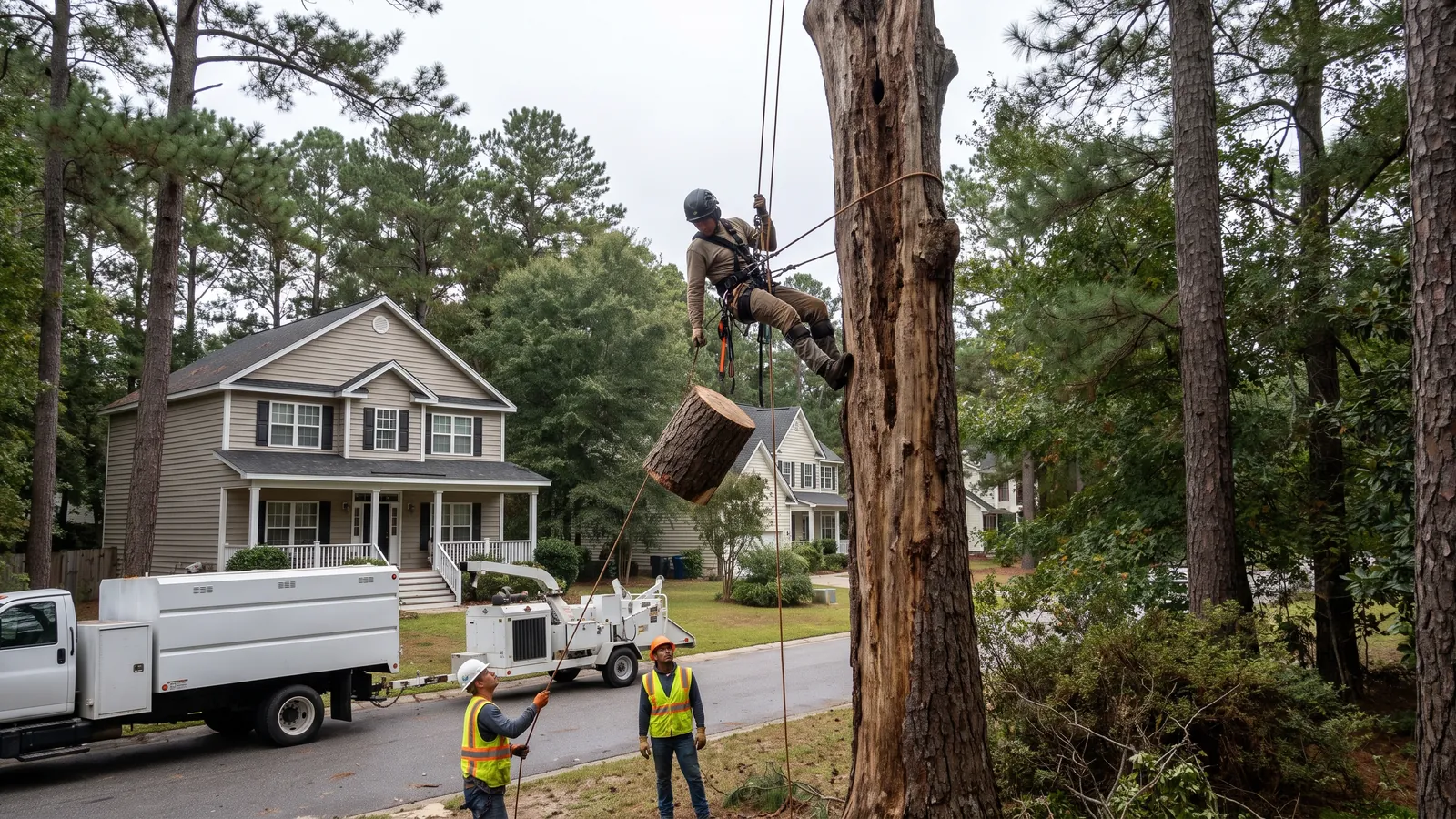
- Rigging over a structure. A tree that can be felled whole is the cheap case; one that has to come down in pieces over a roof, a pool or the neighbor's house takes a climber and a ground crew all day. On a 50-foot beach lot almost everything is rigged.
- Crane. $600–$5,400 on top, or $2,500–$7,500 all-in. Cheaper than two days of small pieces, and the only safe way to take a storm-racked trunk. Neighbors sharing a crane day cut the per-tree cost.
- Stump grinding. $3–$5 per inch of diameter, $100–$150 minimum; a 30-inch oak stump is $300–$550.
- Permits and mitigation. Conway's permits are free. Surfside's zoning permit is no-fee. Myrtle Beach mitigates a significant-tree removal with replacement trees or $400 each; Horry County charges $150 per replacement tree, doubled for live oaks, 1.5× for specimens; North Myrtle Beach's mitigation bank is $300 per caliper inch. An arborist letter for a landmark or specimen is $150–$350. A ZBA or Tree Board hearing is $300–$750 in preparation.
- Haul-off. Included in our prices because the city won't take it; the county landfill charges $22 a ton for yard waste.
- Emergency. Nights, weekends and the days after a named storm add 20–50 percent.
- Access. A tracked grinder and a mini-loader fit through a 36-inch gate; a truck in the yard doesn't. Mats on the sand cost a little and save the lawn.
What a real quote includes
A written, itemized price good for 30 days: the tree identified by species and size, the method (fell, rig, crane), chipping and haul-off, stump grinding as a separate line, the permit for your town and its fee or mitigation, any arborist report, and the certificate of insurance. If a quote is a number on a business card, the number is a guess and the permit is your problem. If a crew on the Strand says they 'don't bother with permits,' the fine — $10,000 for a landmark in Myrtle Beach, $500 an inch on the Neck — is yours.
Common questions
Why is the same tree cheaper in Conway than on the beach?
Access. A Conway lot has room to fell a tree; a Cherry Grove lot has a house on each side and the drop zone is the street. Rigging and crane time are the difference, not the tree.
Is a live oak removal really that expensive?
If it qualifies — and most don't — yes: dense wood, a canopy over everything, usually a crane, plus the town's mitigation. The honest answer on a healthy live oak is almost always a $500–$2,000 pruning instead.
Can I save money by doing the cleanup myself?
A little. We'll cut and stack if you'd rather haul — but remember the city won't collect it, so you'll be driving it to Conway. Leaving the chips as mulch and the rounds as firewood takes money off the haul line.
Do you charge to look at it?
No. The estimate is free. A formal arborist report for a permit or a sale is $150–$350, credited toward the work.
Related: Tree removal · Permits town by town · Crane removal · Stump grinding