Tree service in Conway — where even pruning a landmark oak needs a permit
Conway's ordinance tells the story of Mrs. Mary Beaty standing off a railroad crew with a shotgun in 1887 to save the Wade Hampton Oak. The city has protected its oaks ever since, and the rules are the most particular on the Strand.
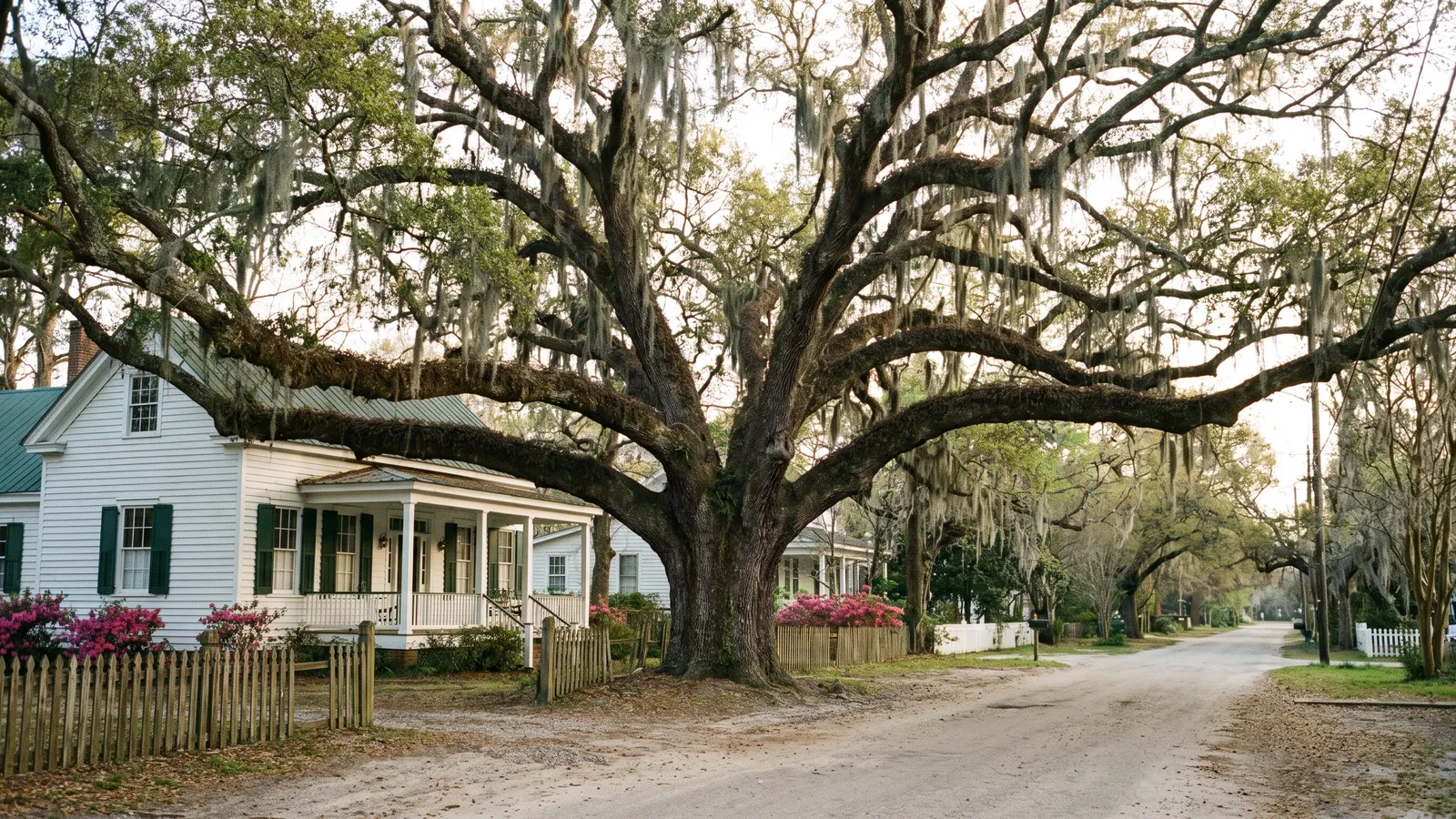
Conway is the county seat on the Waccamaw River, fifteen miles inland from the beach, and it has the Strand's oldest trees and its most carefully written tree ordinance. The city's Unified Development Ordinance protects dogwoods and redbuds from four inches, live oaks and a dozen listed hardwoods — holly, magnolia, red maple, bald cypress, river birch, sycamore, tulip poplar, red cedar, tupelo, ironwood — from eight inches, and every other oak from 14, on any lot. Every live oak 24 inches and up, and every tree on the city's Oaks of Conway map, is a landmark: only the Tree Board can approve removing one, and even pruning one needs a permit. The permits are free and valid six months. Mitigation is inch for inch in four-inch trees, doubled for landmarks; violations are penalized at two or three times the diameter. Topping and lion-tailing are banned. And every paid tree worker signs an affidavit with the permit that they've read the ordinance and will follow ANSI A300. Ours is on file.
The trees themselves are the reason: the live oaks over the historic district and the riverfront, planted when Conway was Kingston and now three and four feet through, Spanish moss and resurrection fern on every limb. Around them is the rest of a river town's canopy — pecans and water oaks in the older neighborhoods, pines in the subdivisions toward Coastal Carolina University and along 501, bald cypress on the river. The ground is different from the beach too: the Waccamaw's clay instead of sand, and a river that set its record at 21.16 feet after Florence in 2018 and flooded the low neighborhoods for weeks. So our Conway work is landmark-oak preservation with the Tree Board's permit, honest assessment of the aging pecans and water oaks, pine work in the newer subdivisions, and storm response when the river comes up.
What we do in Conway
Landmark oak care, permitted
Pruning permits filed with the city for every landmark and Oaks-of-Conway tree; ANSI A300, affidavit on file.
Tree Board applications
The case for a genuinely hazardous landmark oak prepared and presented; the healthy ones pruned instead.
Pecan & water oak assessment
The older neighborhoods' aging hardwoods checked for decay and ranked.
Subdivision pines
Loblollies toward CCU and 501 assessed for beetles, lightning and lean.
River-town storm response
Florence's record crest and every storm since; we answer 24/7, and the ordinance's storm waiver is applied properly.
Free-permit navigation
Which of Conway's thresholds applies, filed for you, valid six months.
Neighborhoods and areas we cover
- Historic District & downtown
- Riverfront / Kingston Lake
- Lakeside
- Red Hill (county)
- Coastal Carolina University area
- Hwy 501 corridor
- Hwy 378 corridor
- Wild Wing Plantation
- Shaftesbury Glen
- Hillsborough
- Elm Street / Main Street oaks
- Hwy 905 / North Conway
Tree services available in Conway
- Tree removal, 24/7 emergency service, crane removal
- Trimming & pruning, live oak care, palmetto & palm trimming
- Pine removal & bark beetles, stump grinding, permits & arborist reports
- Hurricane prep, storm cleanup, lot clearing
Questions from Conway homeowners
Do I really need a permit to prune my own live oak?
In Conway, if it's a landmark — 24 inches or more, or on the Oaks of Conway map — yes, even to prune. For other protected trees the permit is for removal. The permits are free; we file them.
Who decides if a landmark oak can come down?
The Tree Board. We prepare the arborist's assessment, the application and the mitigation plan, and present it at the Board's meeting. A hazardous or declining oak gets approved; a healthy one gets pruned.
What's the affidavit?
Conway requires paid tree workers to sign, with the permit, that they've read the tree ordinance and will follow ANSI A300. It's the city's way of keeping topping crews out. Ours is on file with our business license.
The river flooded my yard and the oak is leaning. Is that an emergency?
Yes. During a declared storm Conway's ordinance has a waiver; otherwise a leaning landmark is a hazard removal with our documentation. Photograph it before anything is cut, and call us.
Nearby: Forestbrook & Socastee · Carolina Forest · Loris & Aynor · Little River & Longs · full service area